

To run a Halloween step challenge at work, pick one theme, set a start date and an end date that lands on or just before October 31, write a scoring rule that everyone can understand in one read, choose prizes before launch, and announce it about a week ahead. The whole setup takes one afternoon. A two-week challenge is enough for a first run, and a one-week version from October 26 to 30 works for a small team or a late start.

- You need four decisions before launch: theme, dates, scoring rule, and prizes. Everything else can be decided during the challenge.
- Score by daily average or by team average, not by raw total. That one rule keeps part-time staff and small teams in the race.
- Prizes do not need a budget. A trophy that moves desks each year and a half-day off work better than most gift cards.
- Across 5,500+ organizations running challenges on Pacer for Teams, employees average 40% more steps after joining a challenge. The theme gets them in, the rules keep them there.
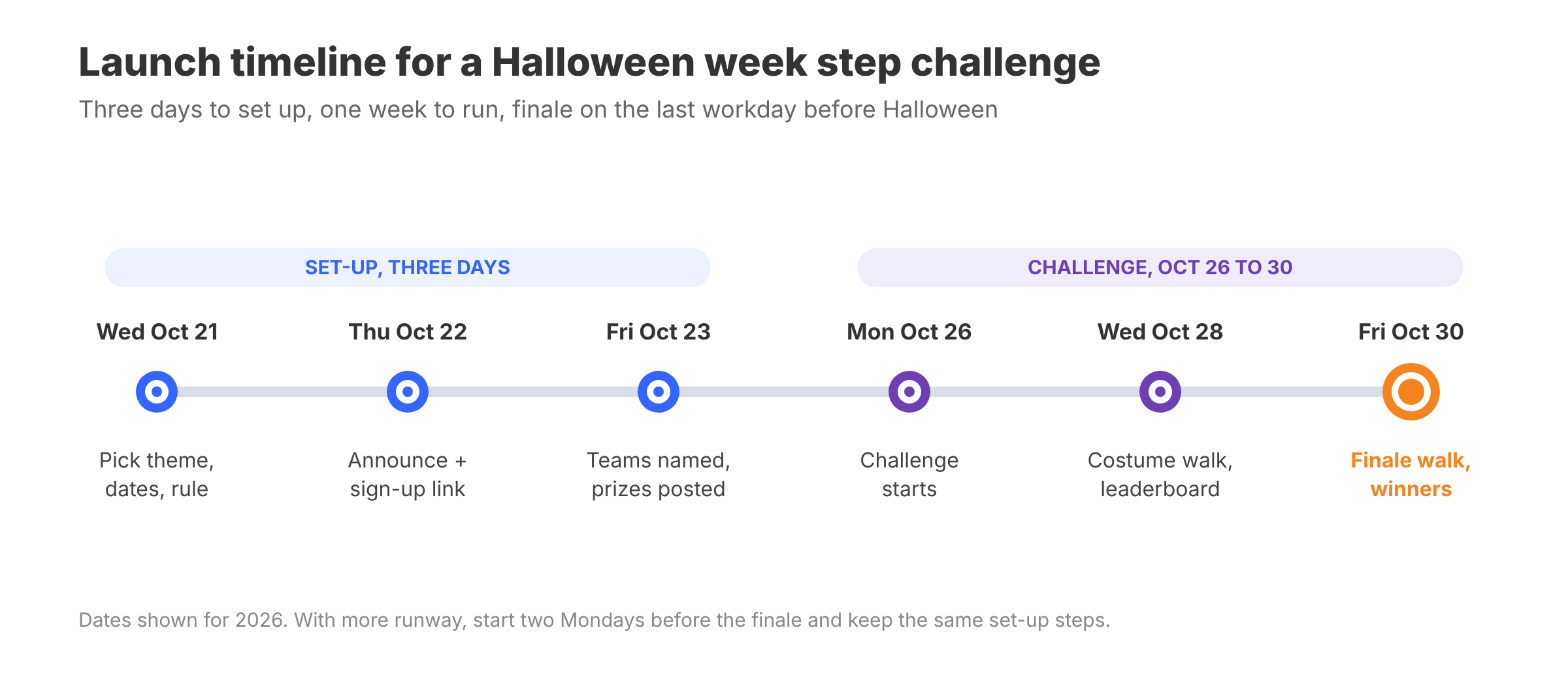
- If you are starting late, Halloween week alone, October 26 to 30, is enough. Announce by Friday the 23rd, start Monday, finish Friday. Anything that ends after Halloween loses the theme.
What You Need Before You Start
Most Halloween step challenges that fail do so before day one, because the organizer tried to decide everything at once. Hosting a step challenge at work in October comes down to four decisions. You only need four things settled before you announce: a theme, the dates, one scoring rule, and the prizes. Team names and mini-events can be added after launch, and adding them mid-challenge is a good way to keep interest up in week two.
If you have never run a step challenge before, read our workplace step challenge guide first. It covers the general setup. This page is the Halloween version: what changes when the whole thing has a theme and a hard deadline.
| Decision | Options | Pick this if you are unsure |
|---|---|---|
| Theme | Haunted route, monster teams, candy bowl, costume week | Monster teams for 20+ people, candy bowl for a smaller office |
| Length | 1 week, 2 weeks, full October | 2 weeks |
| Scoring | Daily average, team average, raw total, streak | Team average |
| Prizes | Trophy, time off, gift cards, charity donation | Trophy plus one small gift card |
How to Run a Halloween Step Challenge in 7 Steps
1. Pick one theme and name the challenge. The theme is the marketing, so choose one that fits your office and stop there. Monster teams (Vampires vs. Werewolves vs. Zombies) suit a bigger company. A candy bowl priced in steps suits a smaller office where everyone shares a kitchen. A haunted virtual route suits remote teams. Give the challenge a name people will repeat, such as "Office Monster Miles" or "The Great Candy Walk-Off." If you want to compare more formats, the 13 Halloween step challenge ideas list has a picker table.
2. Set the dates, starting on a Monday. End on October 31 or on the last workday before it. This year October 31 is a Saturday, so the finale is Friday, October 30. Work backward from there: a two-week challenge starts two Mondays before, a one-week challenge starts October 26. If you are reading this in the last ten days of October, the one-week version is the one to run. Four weeks is the best length for a regular challenge, but a Halloween challenge should not run past the holiday, so shorter is fine.
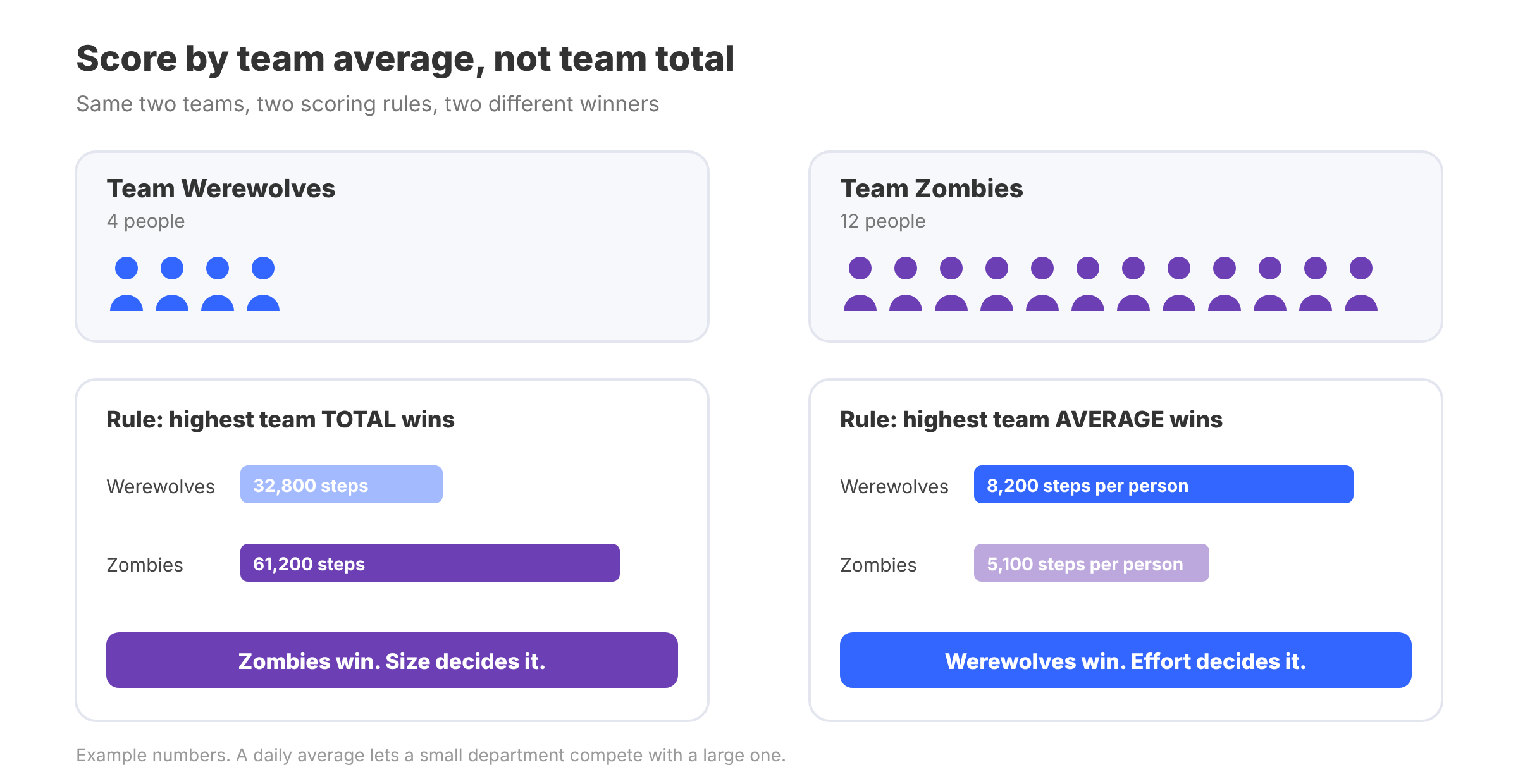
3. Write the scoring rule in one sentence. Pick one of these and do not combine them: highest daily average wins, highest team average wins, or longest streak of days above a goal wins. Team average is the fairest for mixed offices because a team of four can beat a team of twelve. Our step challenge rules guide explains each option and the edge cases, such as what to do about sick days.
4. Decide how steps get counted. Let people use whatever they already have: a phone, a watch, or a basic pedometer. If you are tracking on a spreadsheet, ask for one screenshot per week. If you are using an app, connect it to Apple Health, Google Fit, Fitbit, and Garmin so nobody has to type anything. The fewer manual steps, the fewer disputes. If you are choosing an app for the first time, the step challenge apps for work roundup compares seven.
5. Choose prizes and say what they are in the announcement. People join faster when they know what is at stake. One prize for the winning team, one for the top individual, and one for the best costume on the costume walk is a complete prize list. The section below has options by budget.
6. Announce it a week before the start date. One email and one poster near the kitchen is enough. Lead with the theme and the prizes, then the dates, then a two-line version of the rules. Put the sign-up link or the team-name form at the top, not the bottom. The announcement email templates include a seasonal version you can copy.
7. Post the leaderboard twice a week and end with a real finish. Monday and Thursday updates are enough. On the last day, walk the final mile together and announce winners on the spot. Hand out prizes within the week. Tell people the date of the next challenge while they are still in costume. If sign-ups are slow in the first three days, these 12 participation fixes cover what to do.
Themes That Work in an Office
A good theme does two jobs. It gives people a reason to talk about the challenge, and it gives you a ready-made name for every team and every bonus day. Three themes do this reliably.
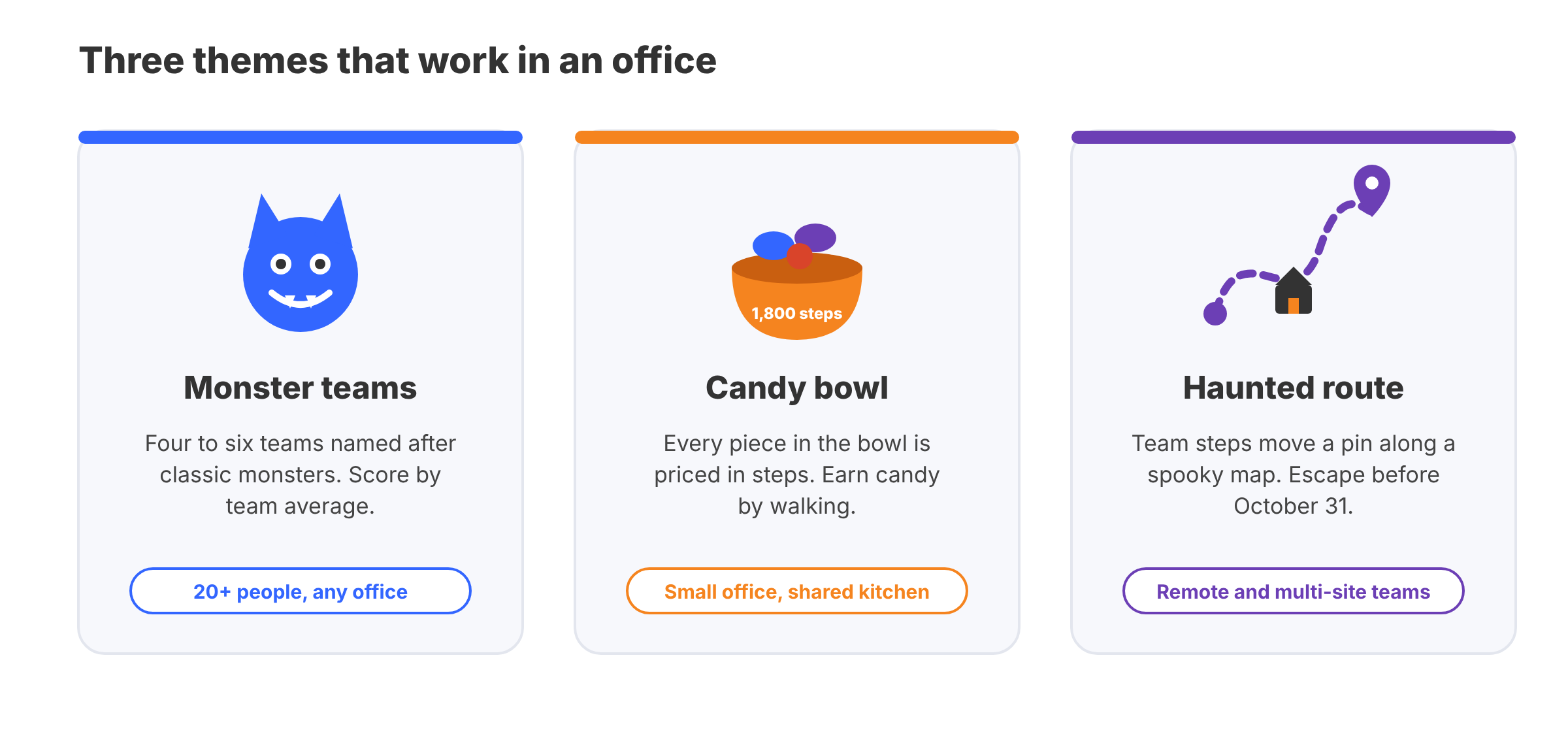
Monster teams. Split the office into four to six teams named after classic monsters and run a team leaderboard. Nobody has to explain the theme, and the rivalry stays friendly because the names are a joke to begin with. Let each team pick its own name from a short list so nobody gets stuck with one they dislike. Our step challenge team names list has a Halloween section to borrow from.
The candy bowl. Price every piece of candy in the office bowl in steps instead of calories. A fun-size chocolate bar is about 80 calories, which works out to roughly 1,500 to 2,000 steps for most adults. People earn candy with steps, and the leaderboard shows who has paid off the most. This theme works best in an office where people share a kitchen, and it works for remote teams if you mail a small bag of candy to each person with a price list.
The haunted route. Set a team step total that equals a famous spooky distance and show progress on a map. Sleepy Hollow to Manhattan is about 30 miles. Whitby to London, Dracula's route, is closer to 250. Teams escape by finishing the route before Halloween. This is the easiest theme for a remote or multi-site company because the map is the shared experience. Pacer for Teams has ready-made Haunted Adventures if you would rather not build the route yourself.
For a month-long version of any of these, the Walktober guide lays it out week by week.
Halloween Step Challenge Rules That Keep It Fair
Halloween challenges have one rule problem that a regular challenge does not: they are short, so one bad weekend or one person with a treadmill desk can decide the whole thing. The fix is in the scoring rule, not in policing.
| Rule | What it says | Why it matters in a short challenge |
|---|---|---|
| Score by average, not total | Team score = average daily steps per member | A team of four can beat a team of twelve, so small departments stay in the race |
| Cap the daily count | Any day over 25,000 steps counts as 25,000 | One marathon Saturday cannot decide a two-week challenge |
| Count every day | Weekends count, sick days count as the team average | Nobody is punished for a weekend plan or a cold |
| One device per person | Steps come from one tracker, declared on day one | Removes the "my watch and my phone both counted" dispute |
| Bonus days announced in advance | Double-point days go on the calendar at launch | Nobody feels ambushed, and people plan walks around them |
Write these five on the announcement and you will not need a rules meeting. If someone asks about a case the rules do not cover, decide it once, post the decision, and that is the rule for everyone from then on. Changing a rule mid-challenge is the fastest way to lose trust, so if you are unsure about a rule, leave it out rather than add it later.
One more rule that is specific to October: decide now whether the costume walk and the finale walk count as steps or as a separate bonus. Either is fine. Not deciding is what causes the argument on day fourteen.
On the daily goal itself, 7,000 to 8,000 steps is also where the health evidence points. A 2022 meta-analysis of 15 cohorts in The Lancet Public Health found that the drop in mortality risk from walking levels off at about 8,000 to 10,000 steps a day for adults under 60, and at 6,000 to 8,000 for adults over 60. A goal in that range is a real target, not a dare.
Halloween Step Challenge Prizes by Budget
Prizes matter less than organizers expect. On Pacer for Teams, the challenges with the highest participation are usually the ones with the clearest theme and the most frequent leaderboard updates, not the biggest prize. But prizes do decide whether people sign up in the first 48 hours, so pick them before you announce.

| Budget | Team prize | Individual prize | Costume walk prize |
|---|---|---|---|
| $0 | A pumpkin trophy that moves desks each year, plus bragging rights in the all-hands | Half a day off, or first pick of parking for November | A photo on the office wall and a title ("Best Costume on Foot, 2026") |
| Under $100 | Team lunch delivered on the last day | $25 gift card | A $10 coffee card |
| $100 to $500 | Team outing (escape room, bowling, a group dinner) | $50 to $100 gift card or a fitness tracker | $25 gift card |
| Charity option | Company donates $1 per 10,000 team steps to a local cause, capped | Winner picks the charity | Costume prize donated in the winner's name |
The charity option is worth a look even with a budget, because it pulls in the people who never care about a leaderboard. The full prize ideas list has 30 more options sorted by budget.
The Announcement, Ready to Copy
Subject: Office Monster Miles starts Monday. Pick your team.
Hi everyone,
From Monday, October 26 to Friday, October 30 we are running a Halloween step challenge. Teams of four to six, named after a monster of your choice.
What you can win: the team with the highest average daily steps gets lunch on the 30th and keeps the pumpkin trophy until next year. The top individual walker gets a half day off.
The rules: every day counts. Days over 25,000 steps count as 25,000. One device per person. Double points on Wednesday the 28th for the costume walk at 12:30.
Sign up and name your team by Friday the 23rd: [sign-up link]
Costumes optional. Walking is not.
[Your name]
Swap the dates, the prizes, the link, and your name. Keep it under 120 words. Longer announcements get skimmed, and the sign-up link is the only thing that needs to be clicked.
Mistakes to Avoid
- Starting without a scoring rule. "We will figure out scoring as we go" means the loudest person decides it in week two. Pick one rule and write it down before the announcement.
- Letting the challenge run past October 31. The theme stops working the day after Halloween, and a challenge that trails into November feels like homework.
- Announcing on the start date. People need a week to find a tracker and join a team. A Monday start with a Monday announcement loses the first week.
- Making the daily goal a dare. A 13,000-step day works as a one-day event. As the daily target, it convinces half the office they cannot win and they stop logging by Thursday.
- Skipping the finish. A challenge that ends with a spreadsheet email and no winners announced is a challenge nobody signs up for again. Fifteen minutes on the last day is enough.
Frequently Asked Questions
How do you run a Halloween step challenge at work?
Pick one theme, set a start date on a Monday and an end date on or just before October 31, write one scoring rule such as highest team average wins, choose prizes before launch, and announce it a week ahead with the sign-up link at the top. Post the leaderboard twice a week and end with a group walk and a winners announcement on the last day.
How long should a Halloween step challenge run?
Two weeks is the best length for a first Halloween challenge, usually the last two full weeks of October. One week works for a small team or a late start. A full month works if you start by the first week of October. Do not run past October 31, because the theme stops working after the holiday.
What is a fair scoring rule for a short step challenge?
Score by team average, cap any single day at 25,000 steps, and count every day including weekends. Those three rules together stop one person or one big weekend from deciding a two-week challenge, and they let a small team compete with a large one.
Do we need an app to run a Halloween step challenge?
No. A spreadsheet and one screenshot per person per week is enough for a small office. An app becomes worth it above about 30 people, when manual entry starts to eat the organizer's time and disputes about counts start to appear.
What are good prizes for a Halloween step challenge?
A trophy that moves desks each year, a half day off, a team lunch on the last day, or a small gift card are enough. The theme is most of the reward. A charity donation tied to total team steps works well for people who do not care about leaderboards.
Can remote employees join a Halloween step challenge?
Yes. Steps are tracked on a phone or watch wherever the person is, so the leaderboard works the same. For the themed events, remote staff join the costume walk on video and do the finale walk in their own neighborhood at the same time. The candy bowl becomes a small mailed bag with a price list.
How far in advance should we announce a Halloween step challenge?
One week before the start date. That gives people time to find a tracker and join a team. Announcing on the start date loses the first week to sign-ups.
The Bottom Line
A Halloween step challenge needs four decisions before launch and about an afternoon of setup. Pick a theme, set dates that end on or before October 31, write one scoring rule, and choose prizes. Announce it a week early and end with a real finish. If you are reading this in the last week of October, Halloween week alone, October 26 to 30, still works. Announce by Friday, start Monday.
If you would rather not run it on spreadsheets, Pacer for Teams tracks steps from any phone or wearable and scores by team average automatically, with Haunted Adventure routes built for October. Start a free 7-day trial and the challenge can be live before Monday.

Leo Lei is a Marketing Specialist at Pacer, where he covers workplace wellness and walking challenges. He works with step data from thousands of companies on Pacer to write practical guides for HR and people teams running their own challenges.