Participation in a workplace step challenge is won before it starts and lost in week three. The two things that move it most are how easy joining is and whether anything happens in the middle of the challenge. Prizes help, but research on workplace wellness programs shows a well-designed program raises participation about as much as paying people to join one.

- Start with the sign-up flow. Every extra step between saying yes and actually being signed up costs you people.
- Week three is when challenges quietly die, so plan something for it before you launch.
- RAND found workplace wellness programs without incentives run a median 20% participation, rising to 40% with rewards, and 59% for comprehensive programs. Design matters as much as prize money.
- Across 5,500+ organizations running challenges on Pacer for Teams, monthly engagement averages 96.9%.
- The troubleshooting table below matches the fix to the symptom you are actually seeing.
Why Step Challenge Participation Stalls
Low participation is rarely about motivation. People want to walk. They fail to join because signing up took four steps and they meant to come back to it, or they join and then never hear about the challenge again until the day it ends.
The research backs up how big the gap is. In RAND's study of workplace wellness programs, employers that offered no incentives reported a median participation rate of just 20%. Adding rewards lifted the median to 40%. The next number is the one to remember. Employers with comprehensive, well-built programs reported 59% participation, and RAND concluded that "offering a rich, well-designed program is almost as effective at boosting employee participation rates as incentivizing employees to join more-limited ones."
In other words, you can buy participation with prize money, or you can earn it with design. The second one is cheaper and it survives to the next challenge.
For comparison, across 5,500+ organizations running challenges on Pacer for Teams, monthly engagement averages 96.9%. That is a different measure from a wellness program sign-up rate, but the lesson is the same: a challenge people want to join beats a program they have to be paid to join.
If you are setting up your first challenge, start with our workplace step challenge guide. This page is about what to do when the challenge exists and the numbers are not what you hoped.
12 Ways to Boost Step Challenge Participation
The list runs in the order you will need it: four things to do before launch, five during the challenge, three at the end.
Before You Launch
1. Announce it twice, a week apart. The first message tells people it exists. The second one, sent two days before the join deadline, is the one that actually converts, because a deadline gets people to act and an announcement does not. Our 8 copy-paste announcement templates cover both messages.
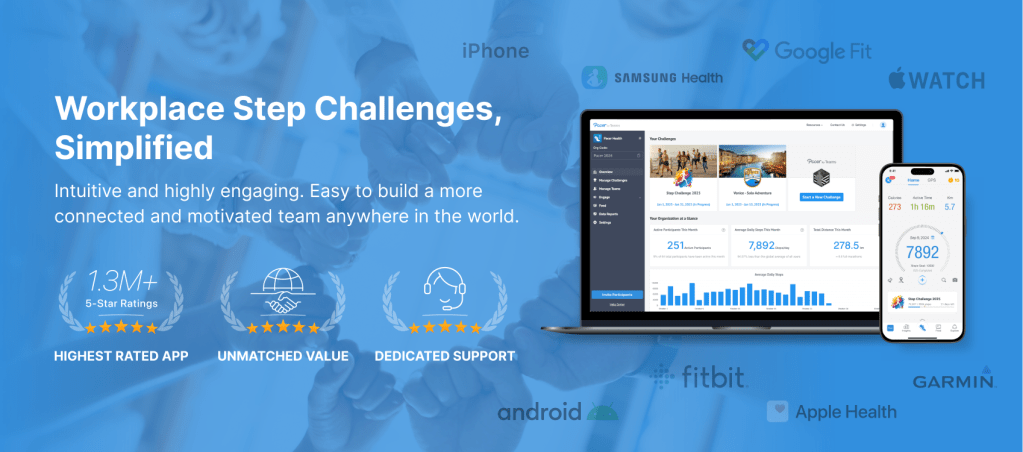
2. Make joining one tap. This is where you lose the most people without ever hearing about it. If joining requires creating an account and entering a company email, you will lose people who fully intended to sign up. A join code that works from a phone in ten seconds removes the whole problem. On Pacer for Teams the phone's built-in pedometer counts steps, so there is no wearable to buy and nothing to set up. If you are still picking a platform, our roundup of the 7 best step challenge apps for work compares how easy each one is to join.
3. Set a goal people believe they can hit. A flat 10,000 steps a day tells anyone currently walking 4,000 that this challenge is not for them, and they are right. Use a team average of 7,000 to 8,000, or ask everyone to beat their own baseline. Our step challenge rules guide covers goal tiers and fair scoring.
4. Recruit five managers before you announce anything. Participation follows the org chart more than any poster does. Get a handful of team leads to commit in advance and to say so in their own team channels. One manager posting "I'm in, who's joining me" outperforms every all-staff email you will ever write.
During the Challenge
5. Put people on teams instead of a solo leaderboard. Individual leaderboards motivate the top 10% and quietly tell everyone else they are losing. Teams of 5 to 10 flip that, because people log their steps so they do not let teammates down. That one change keeps more people going in week two than any prize.
6. Let teams name themselves. It sounds cosmetic and it is not. A team with a name people picked has an identity, and identity survives a bad week. Our step challenge team names list has 150+ if a team gets stuck.

7. Post the leaderboard on a schedule people can predict. Same day, same channel, same format, every week. Predictable beats frequent. A Monday leaderboard people expect gets read; five surprise updates get muted.
8. Celebrate something other than first place. By week two, most teams know they will not win, and a leaderboard that only crowns a winner is telling them to stop trying. Call out most improved, longest streak, biggest single day, best team name. Every extra category you name is another group of people who still have something to play for. Our 30 prize ideas by budget has cheap options for exactly this.
9. Plan a week 3 rescue before you launch. Week three is when the novelty is gone and the finish line still looks far away. Put something on the calendar for it: a themed week, a one-day team sprint, or a single pulse-check question asking whether the daily goal feels right. Deciding what to do in week three during week three is already too late. Our 25 office step challenge ideas has themes you can drop straight in.
After It Ends
10. Announce winners within 48 hours. A challenge that ends on Friday and names winners the following Wednesday teaches everyone that it did not matter much. Fast results teach the opposite, and that is what makes the next challenge easier to fill.
11. Ask one question in the wrap-up. Not a survey. One question: what would make you join the next one? The answers are usually specific and fixable, and people who get asked tend to come back.
12. Book the next challenge before this one ends. Repeat participants join faster and drop out less, because they already know how it works. Put the next start date in the closing announcement. If October is next, Walktober is a ready-made theme for it. Our guide to how long a step challenge should last covers spacing challenges into seasons.

Which Fix Matches Your Problem
Find the symptom you are seeing and go straight to the fix.
| What you are seeing | Usual cause | Go to |
|---|---|---|
| Fewer than half the team signed up | One announcement, or joining takes too many steps | 1, 2 |
| People joined but never logged a step | Tracking setup failed and nobody noticed on day one | 2 |
| Strong week 1, silence by week 3 | Nothing was scheduled for the middle of the challenge | 8, 9 |
| The same team wins every week | A single metric that rewards people who were already active | 3, 8 |
| Remote staff are absent from the leaderboard | The visible parts of the challenge all happen in the office | 5, 7 |
| Nobody signs up for round two | Winners announced late, or no next date was ever given | 10, 12 |
How to Measure Participation
Most teams track one number and it is the wrong one. Sign-ups tell you your announcement worked. They tell you nothing about whether the challenge is working.
Track two rates instead. Sign-up rate is the share of invited employees who joined, and it grades your announcement and how easy joining was. Active rate is the share of joined employees who logged steps in a given week, and it grades the challenge itself. A challenge with 80% sign-ups and a 30% active rate in week two does not have a promotion problem. It has a week three problem arriving early.
Watch the active rate weekly rather than at the end. A drop between week one and week two is the earliest reliable signal you will get, and it leaves you enough time to act on fix 8 or 9 while the challenge is still running.
Frequently Asked Questions
What is a good participation rate for a workplace step challenge?
Use RAND's benchmarks for workplace wellness programs as your reference point: a median of 20% participation without incentives, 40% with rewards, and 59% for comprehensive, well-designed programs. Step challenges usually run above general wellness programs because the activity needs no new skill and the phone does the tracking. For a first challenge, treat half the invited team as a solid result, and expect repeat challenges to do better.
How do you get employees to join a step challenge?
Send two announcements a week apart, make joining a single tap with a join code rather than an account signup, and recruit several managers to commit publicly before the general announcement. Those three moves address the most common reasons people who intended to join never actually did.
Why do people drop out of step challenges?
Most drop-off happens in week three, when the novelty has worn off and the leaderboard gap looks permanent. The two fixes are recognizing more than first place, which keeps people who cannot win in the game, and scheduling a mid-challenge event before the challenge starts.
Do prizes increase step challenge participation?
Yes, but less than most organizers assume. RAND found incentives raise participation by about 20 percentage points, and that employers offering rewards over $100 reported 51% participation versus 36% for smaller rewards. RAND also found that a well-designed program lifts participation nearly as much as incentives do, so prize budget is not the only lever and usually not the cheapest one.
How do you include employees who cannot walk much?
Score on personal improvement rather than raw step totals, so someone going from 3,000 to 4,500 steps competes on equal terms with someone going from 9,000 to 10,500. Let people count cycling, swimming, or wheelchair pushes toward the same goal, so walking is not the only way to score.
How do you get remote employees to participate?
Keep every visible part of the challenge in a channel remote staff already use, rather than in the office. Remote employees join with the same phone code and log walks wherever they live, and a shared team goal gives distributed teams one finish line. Post the leaderboard in the same chat channel each week so nobody has to walk past a wall to see it.
The Bottom Line
Participation is a design problem before it is a budget problem. Make joining easier, put people on teams, name more than one winner, and decide now what happens in week three. If you only do one thing from this list, make joining a single tap, because that is where most of the people you already convinced quietly fall out.
When you are ready to skip the spreadsheet, Pacer for Teams runs the whole thing: phone-only tracking, live team leaderboards, and a join code that takes seconds. Start a free 7-day trial and your next challenge can be live this week.

Leo Lei is a Marketing Specialist at Pacer, where he covers workplace wellness and walking challenges. He works with step data from thousands of companies on Pacer to write practical guides for HR and people teams running their own challenges.