

The best step challenge app for work is the one your employees will still be using in week four. That comes down to a few practical things: automatic tracking from a phone or wearable, a live leaderboard people actually check, admin tools that don't eat your evenings, and a price you can see before a sales call. This guide compares the 7 platforms companies actually shortlist, and tells you plainly which situation each one fits.
- Pacer for Teams is our pick for most companies: published pricing ($454 per month for 100 participants), a self-serve 7-day trial, and a built-in pedometer so nobody needs a wearable.
- Only two options let you start without a sales call: Pacer for Teams (7-day self-serve trial) and Stridekick (free tier).
- Most vendors in this category sell through quote-based demos; only a few publish prices at all.
- Two familiar names changed hands: MoveSpring is now part of Reward Gateway Wellbeing+, and Walker Tracker became Terryberry Be Well.
- Across 5,500+ organizations on Pacer for Teams, monthly engagement averages 96.9%, and employees log about 40% more steps after joining.

How We Compared
Full disclosure first: Pacer for Teams is our product. We put it at the top because the numbers back it up, and where a competitor is the better pick, this guide says so by name.
Every app below was checked against the same five things: pricing transparency (can you see a price without a demo call), how fast you can start (self-serve trial or sales cycle), tracking (does a phone alone work, and which wearables sync), admin tools for HR (setup, reporting, fairness controls), and public ratings on the App Store and G2. Product facts and ratings were checked in August 2026 against each vendor's own site and store listings, and they change, so treat exact numbers as a snapshot.
Two notes on scope. This is a list of platforms an employer can actually buy and administer, so consumer step apps that companies sometimes borrow for informal challenges are out. And the list is deliberately short: seven platforms most HR teams end up shortlisting, each with a full head-to-head review linked in its section, rather than thirty entries you have to sift yourself.
The 7 Best Step Challenge Apps for Work at a Glance
| App | Best for | Pricing | Free option | Phone-only tracking | App Store rating |
|---|---|---|---|---|---|
| Pacer for Teams | Most workplace step challenge programs | Published: $454/month for 100 participants | 7-day self-serve trial | Yes, built-in pedometer | 4.9 (1.1M ratings) |
| YuMuuv | Wellness variety beyond steps | Calculator quote by users and duration | Demo only | Reads from phone health apps | 4.8 (1.6K) |
| Wellable | Full wellness programs with classes and coaching | Tiered quotes; from $625/month, 25-user minimum | Demo only | Reads from phone health apps | 4.6 (3.8K) |
| Big Team Challenge | One-off team events | Per event: £500 for 100 participants, up to 42 days | 5-day trial, up to 10 users | Reads from phone health apps | 4.8 (1.2K) |
| Terryberry Be Well | Wellness bundled with employee recognition | Not published; quote | Demo only | Reads from phone health apps | 4.6 (35K) |
| MoveSpring (Wellbeing+) | Companies already on Reward Gateway | Not published; quote | Demo only | Reads from phone health apps | 3.8 (312) |
| Stridekick | Casual social challenges | Free to start | Free tier | Reads from phone health apps | 4.5 (3.5K) |
1. Pacer for Teams: Best for Most Workplace Step Challenge Programs
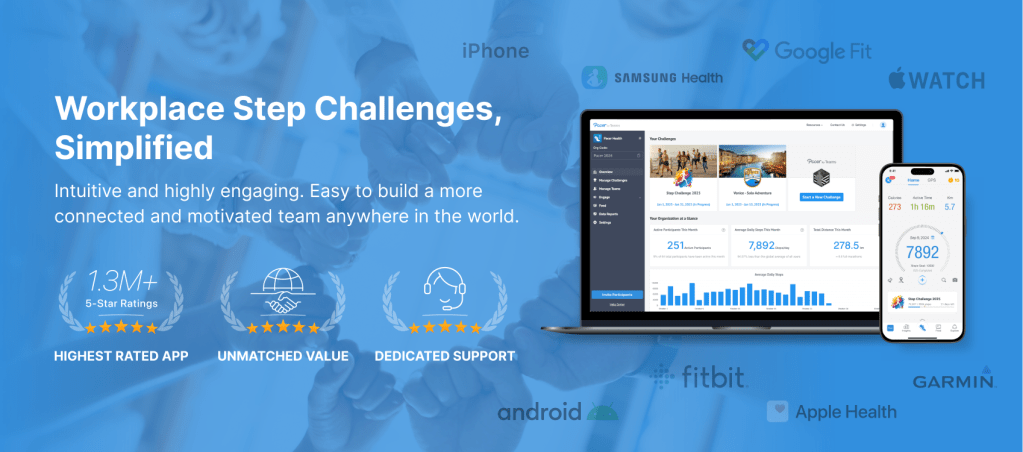
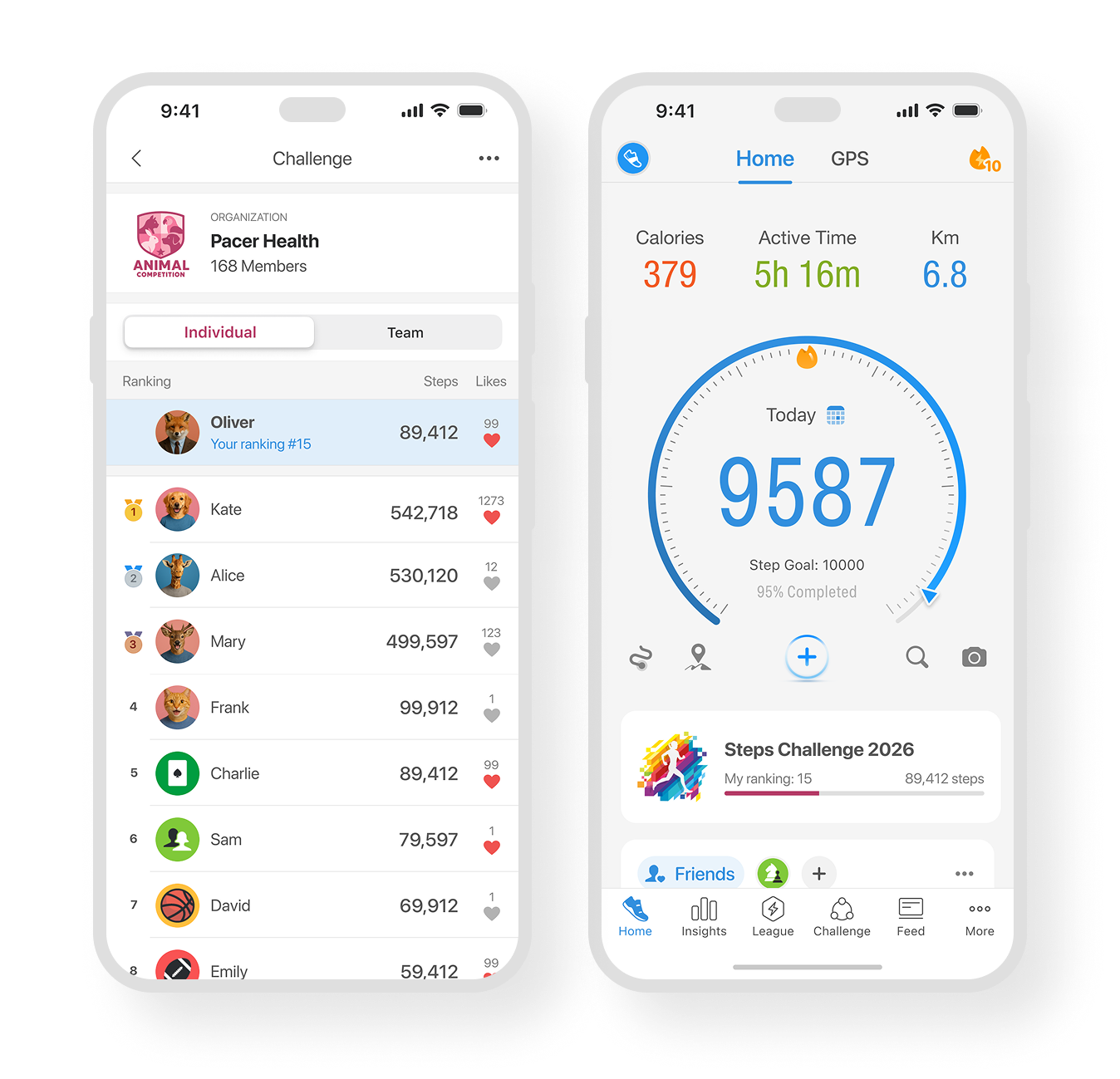
Pacer for Teams is a dedicated step challenge platform built on the Pacer walking app, which 100M+ people already use to count steps. That base changes the rollout math: many employees have the app installed before your announcement email goes out, and everyone else joins with just a phone, because the pedometer is built in.
The program side is built for year-round use. Admins get 6 challenge types (step, distance, daily goal, Virtual Race, Virtual Adventure on real-world routes, plus habit and wellness challenges), score adjustments, reporting, and API access, and challenges run back to back on one subscription. The formats have been refined across 18,000+ workplace challenges. Across 5,500+ organizations, monthly engagement averages 96.9%, and employees log about 40% more steps after joining.
Two things in this category are still rare and worth naming: pricing is published ($454 per month for 100 participants, other sizes on the pricing page), and the 7-day trial is self-serve. You can run a real pilot this week without talking to anyone.
2. YuMuuv: Best for Wellness Variety Beyond Steps
YuMuuv is an Estonian wellness challenge app covering 18+ challenge types, from steps and cycling to sleep, water, and reading, in 47 languages. Every account gets a dedicated success manager, and device support is unusually wide, including Suunto and Polar. It rates 4.8 on the App Store across 1.6K ratings, and 4.6 across 1,115 reviews on G2.
Pricing comes from a calculator based on registered users and challenge duration, confirmed on a demo call, with no advertised free plan. Challenges are priced as periods, so a year-round program means committing up front or rebooking as you go. Full comparison: Pacer for Teams vs YuMuuv.
3. Wellable: Best for Full Wellness Programs
Wellable sells a wellness program, not just challenges: 40+ challenge types across physical, mental, financial, and social wellness, plus 2,500+ on-demand classes, health coaching, and a rewards wallet. It holds 4.7 stars across 1,281 G2 reviews and 4.6 on the App Store. Essentials starts at $625 per month with a 25-user minimum and a one-year standard contract, sold through a quote.
If your company is buying a whole wellness benefit under one contract, this is the strongest bundle on the list. If you mainly want a step challenge, you are paying for a program around it. Full comparison: Pacer for Teams vs Wellable.
4. Big Team Challenge: Best for One-Off Events
Big Team Challenge, from the UK, sells step challenges as standalone events: £500 covers up to 100 participants for up to 42 days, with 340+ themed virtual routes and a JustGiving integration for charity tie-ins. Clients include UPS, Nestlé, and NHS teams, and the app rates 4.8 on the App Store across 1.2K ratings.
The per-event model is the point and the limit: clean for an annual charity walk, expensive and stop-start for a continuous program, since each challenge is a new purchase and nothing runs between events. Full comparison: Pacer for Teams vs Big Team Challenge.
5. Terryberry Be Well: Best with Employee Recognition
Walker Tracker was a well-known name in this category until Terryberry acquired it in 2022 and folded it into the Be Well platform, where step challenges sit alongside recognition and rewards programs. Its standout feature converts 120+ non-step activities into step equivalents, and the app holds 4.6 stars across 35K App Store ratings. There is no published pricing; you buy through a Terryberry sales conversation.
If your company already runs Terryberry recognition, keeping wellness under the same contract is the draw. Full comparison: Pacer for Teams vs Walker Tracker.
6. MoveSpring (Wellbeing+): Best Inside Reward Gateway
MoveSpring built a loyal following as a standalone step challenge app, then became part of Reward Gateway, where it now lives as Wellbeing+; movespring.com redirects there. Pricing is quote-based within the wider Reward Gateway benefits platform, and the MoveSpring app now rates 3.8 on the App Store across 312 ratings.
For companies already on Reward Gateway, adding Wellbeing+ keeps everything under one vendor. For everyone else, the standalone product you may remember is no longer what is for sale. Full comparison: Pacer for Teams vs MoveSpring.
7. Stridekick: Best for Casual Social Challenges
Stridekick is a free-to-start social stepping app built around challenges with friends, rated 4.5 across 3.5K App Store ratings. It is easy to like for informal groups: setup takes minutes and there is no budget conversation. It is built for social use rather than admin-run company programs, so HR-side tooling is thin, and organized workplace needs point you toward the platforms above. Full comparison: Pacer for Teams vs Stridekick.

What to Look For in a Step Challenge App
Five things separate a challenge people finish from one that dies in week two.
- Automatic tracking. Manual step entry is the fastest way to lose people and the fastest way to start arguments about fairness. Steps should sync from a phone or wearable on their own.
- No hardware requirement. If joining means buying a Fitbit, participation drops before the challenge starts. A built-in pedometer, or reliable sync from the phone's own health app, keeps the door open to everyone.
- Pricing you can see. Most vendors in this category quote per deal. A published rate lets you budget in an afternoon instead of a sales cycle.
- Admin tools that match your program. One event a year needs very little. A year-round program needs scheduling, score adjustments, reporting, and someone to call when a leaderboard looks wrong.
- A trial before you commit. Running a two-week pilot with one department tells you more than any feature list. Check whether you can start one without a signature.
Which Should You Choose?
Match the app to the program you are actually running.
- A year-round company program: Pacer for Teams. Published price, self-serve trial, phone-only tracking, challenges back to back.
- Zero budget, casual group: Stridekick, and accept doing the admin by hand.
- A wellness calendar that goes well beyond walking: YuMuuv for challenge variety, Wellable if you also want classes and coaching.
- One event a year: Big Team Challenge.
- Already on Terryberry or Reward Gateway: Be Well or Wellbeing+ keep it under your existing contract.
Whichever you pick, the challenge design matters as much as the software. Our guide on how to run a workplace step challenge covers goals, duration, and rules, and 150+ step challenge team names solves the naming meeting.

Frequently Asked Questions
What is the best step challenge app for work?
Pacer for Teams is the strongest pick for most workplace programs: published pricing ($454 per month for 100 participants), a self-serve 7-day trial, a built-in pedometer so no wearable is required, and 96.9% average monthly engagement across 5,500+ organizations. The best pick shifts when your needs shift, such as Big Team Challenge for a one-off event or Wellable for a full wellness program.
Is there a free step challenge app for teams?
Yes, with limits. Stridekick is free to start for casual groups, though HR-side tooling is thin. The Pacer app is free for individuals, and Pacer for Teams adds the admin console, company-wide challenges, and reporting on a self-serve 7-day free trial.
How much does a step challenge app cost?
Most vendors quote per deal, so public numbers are rare. The published reference points: Pacer for Teams charges $454 per month for 100 participants, Big Team Challenge charges £500 per event for up to 100 participants, and Wellable starts at $625 per month with a 25-user minimum. YuMuuv, Terryberry Be Well, and Wellbeing+ are quote-based.
Do employees need a Fitbit or wearable to join a step challenge?
Not on every platform. Pacer for Teams includes a built-in pedometer, so a phone alone works. Most other platforms read steps from phone health apps or wearables rather than counting steps themselves. Making wearables optional keeps participation high.
What happened to MoveSpring and Walker Tracker?
Both were acquired. MoveSpring is now part of Reward Gateway and sold as Wellbeing+, with movespring.com redirecting there. Walker Tracker was acquired by Terryberry in 2022 and became part of the Terryberry Be Well platform. Neither is sold as a standalone step challenge product anymore.
How long should a workplace step challenge run?
Four to eight weeks works best: long enough for a habit to form, short enough that people finish. Run four weeks for a first challenge, then schedule the next one before it ends. The full setup is in our step-by-step guide.
How many employees do you need for a step challenge?
There is no minimum that makes a challenge work, but pricing minimums vary: Wellable requires 25 users, Big Team Challenge prices in blocks of 100, and Pacer for Teams scales from small teams up. Team-based scoring works better than individual leaderboards once you pass about 20 people, because it keeps casual walkers involved.
Can employees join a step challenge from different countries and time zones?
Yes, on any of the platforms here. What differs is the detail: check whether the app supports your employees' languages (YuMuuv covers 47), whether step totals reconcile across time zones, and whether the leaderboard shows everyone on one board rather than splitting by office.
What is the difference between a step challenge app and a wellness platform?
A step challenge app is built around movement: steps, distance, leaderboards, and the admin tools to run those. A wellness platform bundles challenges with content and services such as classes, coaching, or rewards, and usually sells on an annual contract. Pacer for Teams and Big Team Challenge sit in the first group; Wellable, YuMuuv, Terryberry Be Well, and Wellbeing+ sit in the second.
The Bottom Line
Seven apps, three honest buckets: dedicated step challenge platforms (Pacer for Teams, Big Team Challenge), wellness suites where steps are one module (YuMuuv, Wellable, Be Well, Wellbeing+), and social apps built for casual groups (Stridekick). If you want a step challenge employees stick with and a price you can see today, start the Pacer for Teams free trial and judge it against this list yourself.

Leo Lei is a Marketing Specialist at Pacer, where he covers workplace wellness and walking challenges. He works with step data from thousands of companies on Pacer to write practical guides for HR and people teams running their own challenges.