

Big Team Challenge and Pacer for Teams both run workplace step challenges, but they are built on different models. Big Team Challenge, a UK-based company, sells each challenge as a standalone event: you buy a challenge of up to 42 days and run it, and the program ends when the event does. Pacer for Teams is a subscription platform designed to keep employees moving all year, with 6 challenge types and admin tools for running challenges back to back.
- Big Team Challenge charges per event: £500 covers up to 100 participants for up to 42 days, with £4.40 per extra participant billed after the challenge ends.
- Pacer for Teams publishes its pricing ($454 per month for 100 participants) and offers a 7-day free trial you can start today, no sales call required.
- Big Team Challenge is built around one-off events: 340+ themed virtual routes, a JustGiving fundraising integration, and challenges capped at 42 days (12 weeks on Extended).
- Across 5,500+ organizations on Pacer for Teams, monthly engagement averages 96.9%, and employees log about 40% more steps after joining.
- Employees can join a Pacer for Teams challenge with just their phone. No wearable required.
Neither model is universally better. Renting a bounce house is the right call for one afternoon, and Big Team Challenge is built as exactly that: a per-event product. But if you want walking to become something your company just does, rather than something it did once in April, the two platforms behave and price very differently. Here is the full picture, with real numbers for both.

How Big Team Challenge's Pricing Works
Big Team Challenge publishes its prices through an online calculator, which is uncommon in corporate wellness. A Base challenge starts at £500, which includes 100 participants and a maximum length of 42 days. An Extended challenge starts at £560 and can run up to 12 weeks. Every participant beyond the first 100 costs £4.40, billed after the challenge finishes. Challenges for more than 1,000 people move to custom Enterprise pricing.
The £500 headline is real, but it is the starting point, not the total. Managed challenge services start at £250 and go up to £1,000 or more. Custom reporting starts at £100, and a custom virtual route starts at £150. There is a free trial, but it lasts 5 days and caps at 10 users. You also have to email the company to switch it on, which is a strange amount of friction for something called a free trial.
The bigger catch is structural: every challenge is a separate purchase. When the event ends, access ends with it, and so does the momentum your team just built. Want a spring challenge and a fall challenge? That means paying twice, and asking your boss to approve the same expense twice.
Pacer vs Big Team Challenge at a Glance
| Pacer for Teams | Big Team Challenge |
|---|---|
| Best for | |
| Year-round step challenge programs of any size | One-off team challenge events |
| Pricing model | |
| Published subscription: $454/month for 100 participants | Published per event: £500 for 100 participants, up to 42 days |
| Free option | |
| 7-day free trial, self-serve, no credit card | 5-day trial, up to 10 users, contact required |
| Challenge length | |
| Flexible, admin-defined, runs year-round | 42 days max (12 weeks on Extended) |
| Challenge types | |
| Step, Distance, Daily Goal, Virtual Race, Virtual Adventure, habit and wellness | Team step challenge on a virtual route, in 2 team modes |
| Virtual routes | |
| Virtual Adventure Challenges on real-world routes | 340+ themed routes, custom routes from £150 |
| Phone-only tracking | |
| Yes, built-in pedometer | Syncs from Apple Health and Google Fit; iOS and Android apps |
| Wearables | |
| Apple Watch, Fitbit, Garmin, and more | Fitbit, Garmin, Apple Health, Google Fit |
| Admin tools | |
| Admin console, score adjustments, reporting, API access | Web dashboard; custom reporting from £100; managed services from £250 |
| Charity features | |
| Challenge messaging and team fundraising tie-ins | JustGiving integration; 1 tree planted per 10 active participants |
| App ratings | |
| 4.9 App Store (1.1M ratings); 4.8 Google Play (970K reviews) | 4.8 App Store (1.1K ratings); 4.5 Google Play (1.8K reviews) |
| Scale | |
| 5,500+ orgs, 450K+ participants, 190+ countries | 400,000+ users; clients include UPS, Nestlé, and NHS teams |
Which Platform Fits Your Team?
Choose Pacer for Teams if you want wellness to be a program, not an event. A subscription covers as many challenges as you want to run, so January's step challenge can roll into a spring distance challenge without a new purchase order. You get published pricing you can put in a budget request and a 7-day free trial you can start today. Phone-only tracking lets every employee join without buying a device.
Choose Big Team Challenge if you are planning a single, self-contained event and the themed route experience matters more than continuity. It has a JustGiving integration for charity fundraisers, and its managed service tiers (from £250) mean the vendor can run the event for you.
Feature by Feature
Challenge Types and Duration
Big Team Challenge does one thing: team step challenges plotted on virtual route maps. Teams either progress separately along the route or combine steps to move together, and the challenge ends at 42 days (or 12 weeks on the Extended plan). That focus keeps setup simple, but there is nowhere to go after the finish line. The challenge ends, the app goes quiet, and day 43 is just a regular Wednesday.
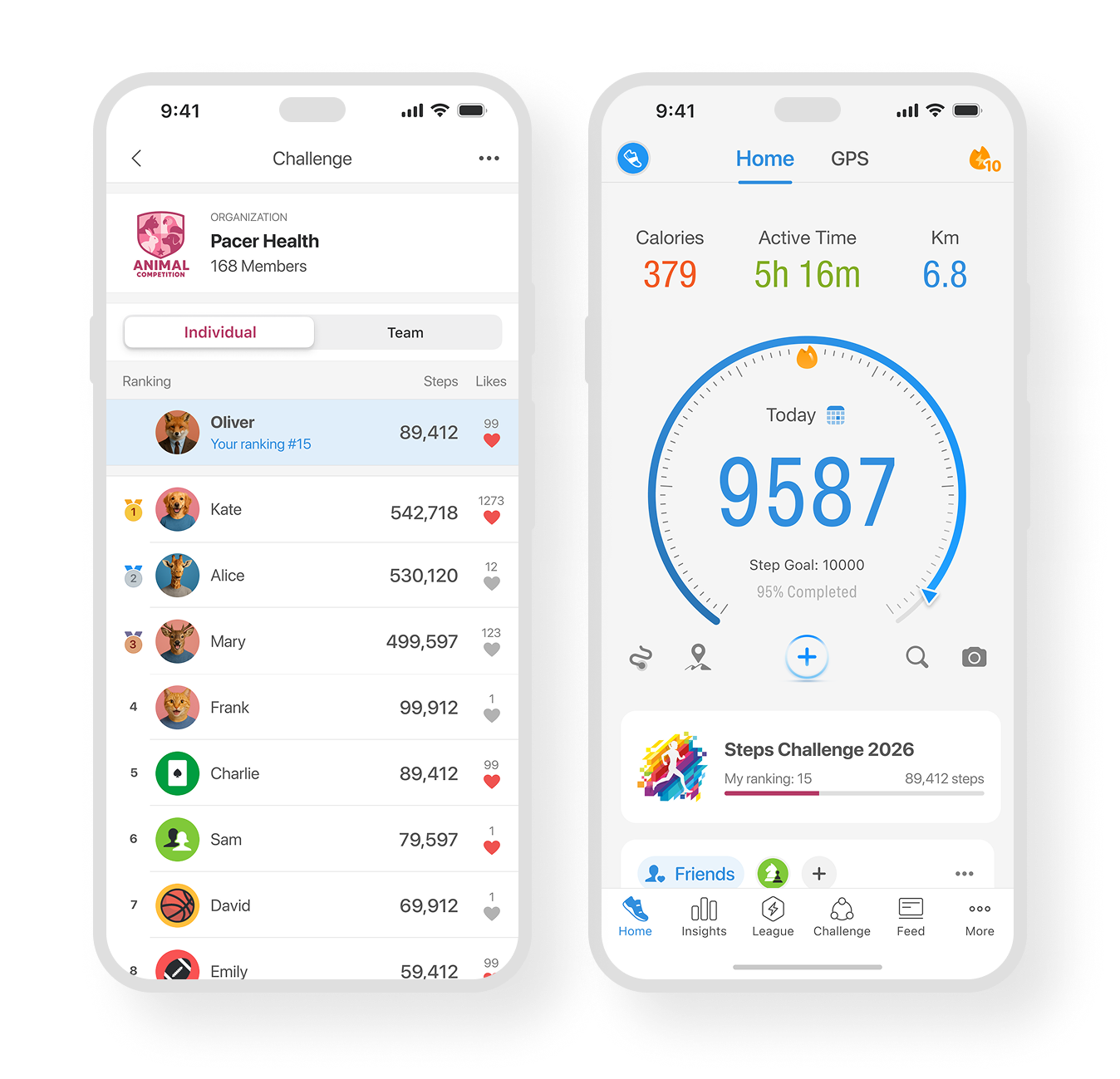
Pacer for Teams supports 6 challenge formats, including Step, Distance, Daily Goal, Virtual Race, and Virtual Adventure, plus habit and wellness challenges that reward consistency over raw step counts. Admins set the dates, so a challenge can be a 2-week sprint or a quarter-long program.
Tracking and Devices
Both platforms sync with the major trackers: Fitbit, Garmin, Apple Health, and Google Fit. The difference is what happens for employees who own no wearable at all. Pacer's built-in pedometer turns any phone into the tracking device, which removes the most common excuse for sitting a challenge out: "I don't own a Fitbit." It also helps that many employees already know the consumer Pacer app, which holds a 4.9 rating on the App Store (1.1M ratings) and 4.8 on Google Play (970K reviews).

Admin and Reporting
Pacer for Teams includes an admin console with participant management, score adjustments, exportable reports, and API access, all part of the subscription. On Big Team Challenge, the standard dashboard covers the basics, while custom reporting is a paid add-on starting at £100. Its managed service tiers (from £250) are the honest answer for teams that want to outsource administration entirely.
Pricing: Per-Event Billing vs a Monthly Subscription
Both vendors publish real numbers, which makes this comparison unusually straightforward. A 6-week Big Team Challenge for 100 people costs £500 flat. Pacer for Teams costs $454 per month for the same headcount.
An honest read: if your company runs exactly one 6-week challenge a year and nothing else, Big Team Challenge's per-event pricing will likely cost less. We would be a strange comparison page if we pretended otherwise. The subscription pays off when challenges become a program. One monthly price covers unlimited challenges, year-round leaderboards, habit programs between events, and admin reporting, with no repurchasing cycle and no per-participant true-up bill after each event.
Budget owners should also factor in the add-ons. On Big Team Challenge, custom reports, custom routes, and hands-on management each carry their own fee, so the invoice can land well above the base price.
When Big Team Challenge Is the Better Fit
An honest comparison cuts both ways. Big Team Challenge lists 340+ themed virtual routes, more than any platform in this comparison, so a team can walk a mapped route from London to Rome without leaving the office park. It integrates with JustGiving for charity fundraising and plants a tree for every 10 active participants. Charities and public sector organizations get discounts, and its managed service tiers mean the vendor can run the event end to end. If your event is a one-off with a defined start and end date, those features may be all you need.
How to Switch from Big Team Challenge to Pacer for Teams
Switching is easy, because Big Team Challenge bills per event. There is no contract to break and no awkward cancellation call. You simply do not buy the next event.
1. Let your current challenge finish. Per-event billing means access simply ends with the event, so time the switch for the gap between challenges.
2. Export your results. Download final leaderboards and reports from the Big Team Challenge dashboard while you still have access.
3. Start a Pacer for Teams free trial. The 7-day trial covers up to 10 users and requires no credit card, so your wellness committee can test it before rollout.
4. Set up your first challenge. Pick a challenge type, set the dates, and invite employees with a join code. Most admins finish setup in under an hour.
5. Launch, then plan the next one. Announce the challenge, and schedule the follow-up before the first one ends so engagement carries through the year.

First time running a challenge? Our step-by-step guide to running a workplace step challenge covers goals, rules, and the announcement plan.
Frequently Asked Questions
Is Pacer for Teams a good Big Team Challenge alternative?
Yes, especially if you want step challenges to run all year instead of as one-off events. Pacer for Teams publishes its pricing ($454 per month for 100 participants) and offers a 7-day free trial with no sales call. Its app holds a 4.9 rating on the App Store (1.1M ratings) and 4.8 on Google Play (970K reviews), and employees can join with just their phones.
How much does Big Team Challenge cost?
Big Team Challenge starts at £500 for a challenge with up to 100 participants and a maximum length of 42 days. Extra participants are billed at £4.40 each after the challenge ends, and an extended 12-week version starts at £560. Managed services, custom reports, and custom routes cost extra.
What is the difference between Pacer for Teams and Big Team Challenge?
Big Team Challenge sells individual challenge events with a set start and end date, priced per event. Pacer for Teams is a subscription platform built for continuous wellness programming, with 6 challenge types and admin tools for running challenges back to back throughout the year.
Does Big Team Challenge work with Fitbit and other wearables?
Yes. Big Team Challenge syncs steps from Fitbit, Garmin, Apple Health, and Google Fit, and offers iOS and Android apps alongside its web dashboard. Pacer for Teams supports the same major wearables and also includes a built-in phone pedometer, so employees without a device can still join.
Can you run a year-round wellness program on Big Team Challenge?
Not easily. Big Team Challenge caps standard challenges at 42 days and extended challenges at 12 weeks, and each new challenge is a separate purchase. Teams that want continuous programming usually need a subscription platform built for back-to-back challenges.
Does Big Team Challenge offer anything Pacer for Teams doesn't?
Yes. Big Team Challenge has a library of 340+ themed virtual routes, a JustGiving integration for charity fundraising, and a program that plants a tree for every 10 active participants. It also sells fully managed challenge services, which helps when nobody on your team has time to run the event.
The Bottom Line
Big Team Challenge is a per-event tool. If your company wants a single 6-week challenge with a themed route or a charity angle, it covers that use case, and its pricing is published so you know the cost up front.
Pacer for Teams is built for what happens after the event. With published pricing, a self-serve free trial, 6 challenge types, phone-only tracking, and 96.9% average monthly engagement across 5,500+ organizations, it turns a step challenge from an annual event into a wellness program that runs all year. Start a free 7-day trial and see how your team responds.
Comparing more platforms? See how Pacer for Teams stacks up against MoveSpring and Stridekick, or see all seven options in our roundup of the best step challenge apps for work.
Competitor data sourced from bigteamchallenge.com, G2, and Capterra in August 2026. Details change, so verify with each vendor before you buy. Spot something out of date? Let us know and we will fix it.

Leo Lei is a Marketing Specialist at Pacer, where he covers workplace wellness and walking challenges. He works with step data from thousands of companies on Pacer to write practical guides for HR and people teams running their own challenges.