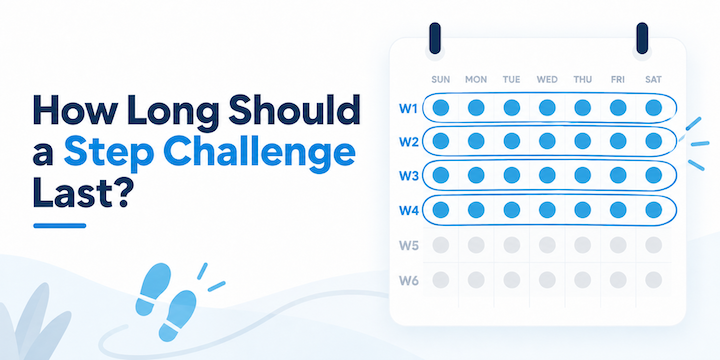


Most workplace step challenges work best at four weeks. That is long enough for the leaderboard to matter and short enough to finish before motivation fades, which usually starts in week three. One-day and one-week challenges fit awareness events, and anything past six weeks tends to lose more walkers than it gains.

- Four weeks is the best default length for a workplace step challenge. It fills a calendar month and ends before the novelty runs out.
- Week three is when most challenges start losing people, so the length you pick should leave room for a mid-challenge rescue.
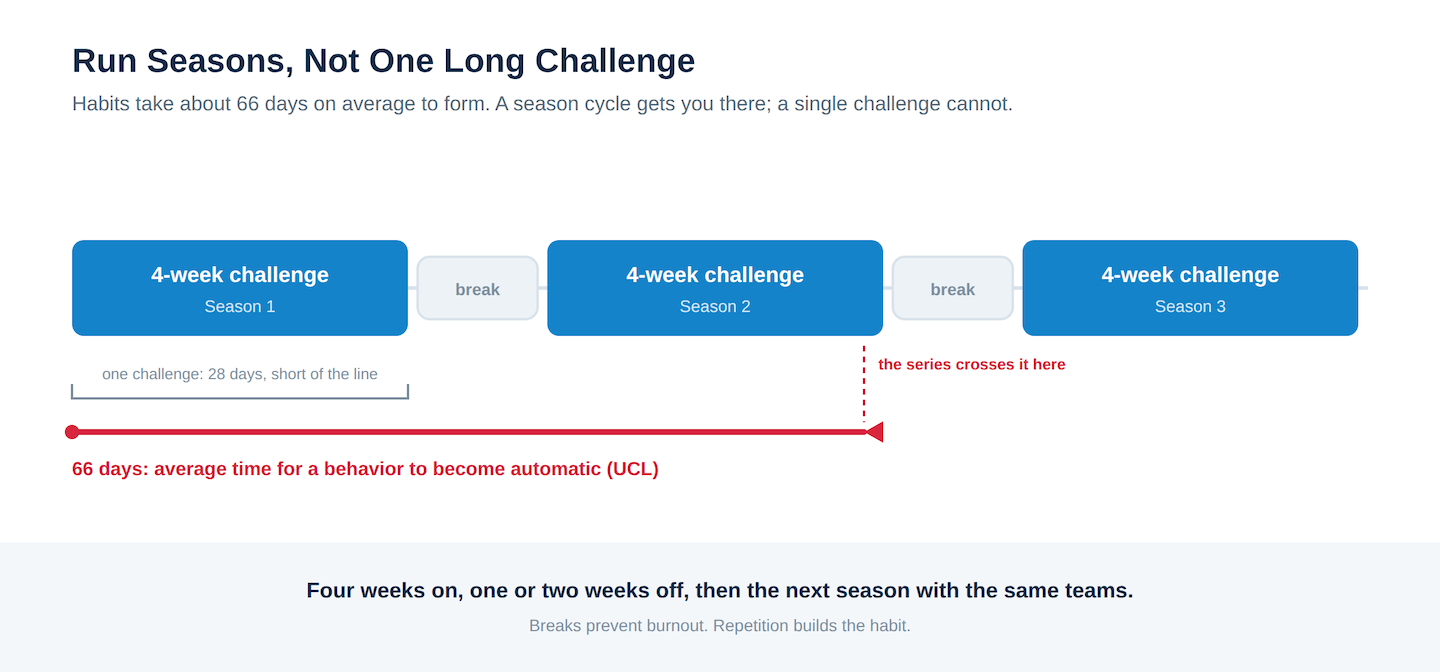
- Habits take about 66 days on average to form, longer than any sensible challenge. The fix is a series of short challenges, not one long one.
- Across 5,500+ organizations running challenges on Pacer for Teams, monthly engagement averages 96.9%, and average-based goals hold that engagement better than long timelines do.
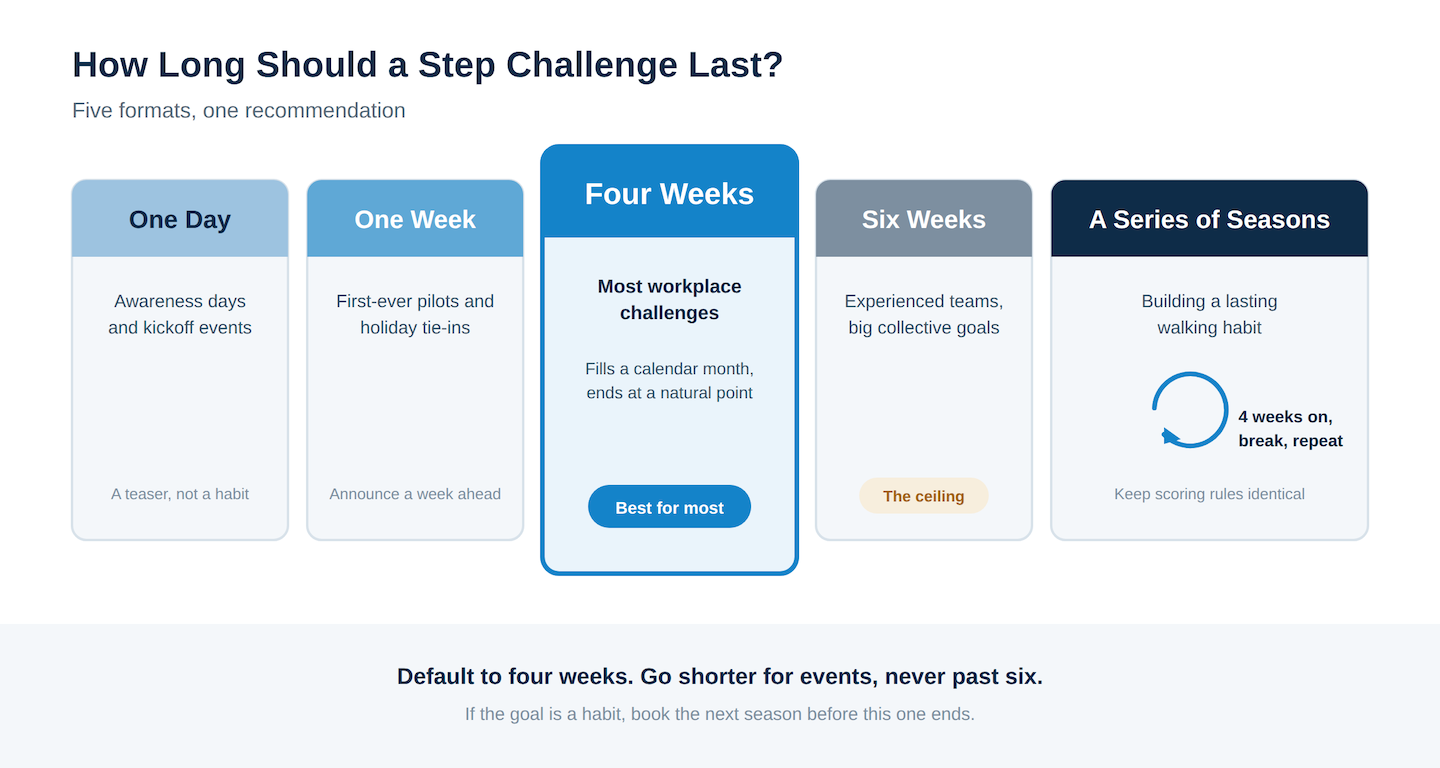
- The duration table below matches each length to the situation it fits.
The Short Answer by Scenario
Pick the row that matches your situation. The rest of this guide explains the reasoning.
| Duration | Best for | Why it works | Watch out |
|---|---|---|---|
| One day | Awareness days, kickoff events | Zero commitment asked, high turnout | No habit effect; treat it as a teaser for a longer challenge |
| One week | First-ever pilots, holiday tie-ins | Long enough for a leaderboard, short enough that nobody drops out | Announce a week ahead or half the office misses it |
| Four weeks | Most workplace challenges | Fills a calendar month, leaderboard develops real stakes, ends at a natural point | Plan a week 3 theme or pulse check before the slump hits |
| Six weeks | Experienced teams chasing a big collective goal | Room for a longer story arc and bigger totals | This is the ceiling; drop-off compounds every week past four |
| A series of seasons | Building a lasting walking habit | Repetition is what forms habits, and breaks prevent burnout | Keep scoring rules identical between seasons |
The full setup playbook lives in our workplace step challenge guide. This page settles the one question that guide gets asked most.
Why Four Weeks Works for Most Teams
A four-week challenge lines up with how offices actually run. It fits inside a calendar month, so "the October challenge" is easy to announce and easy to remember. Payroll cycles, team meetings, and monthly reports all give you natural moments to talk about it.
The leaderboard math matters too. In week one, everyone is close together and anything feels possible. By week two, rivalries form. A challenge that ends after seven days cuts that story off early, and one that runs past six weeks lets the gap between first and last place grow so wide that trailing teams quietly stop logging.
Then there is week three. Most challenges lose people in week three, when the novelty is gone and the finish line still feels far away. A four-week format keeps that danger zone short: one themed week or a single pulse-check question ("is the daily goal too high?") is usually enough to carry teams through to the finale. Across 5,500+ organizations running challenges on Pacer for Teams, monthly engagement averages 96.9%, and the challenges that hold it are the ones that treat week three as a planned event rather than a surprise.
When Shorter Is Better
Run a shorter challenge in two situations.
The first is a pilot. If your company has never done a step challenge, a one-week version answers every scary question cheaply: will people join, does tracking work, do managers play along. A week is enough to test all of it, and a strong week one makes the four-week sequel an easy sell.
The second is a calendar event. Awareness days come with a built-in date and built-in motivation, so match the challenge to the moment instead of stretching it. A World Heart Day walking challenge runs beautifully as a single focused week around September 29. Whatever the length, send a real announcement at least a week before day one, because short challenges have no time to recover from a slow start.
What If the Goal Is a Lasting Habit?
Here is the trap: if walking habits are the real goal, the obvious move is a longer challenge. The research says otherwise.
A UCL study tracking people as they built new daily behaviors found it took 66 days on average for a behavior to become automatic, and people who performed the behavior inconsistently did not form the habit at all. No workplace challenge should run 66 days straight. By then you are deep past the six-week ceiling and the leaderboard is a ghost town.
A 2020 Cochrane review of 14 workplace pedometer studies covering 4,762 participants points at the same problem from the other side: programs showed positive effects while they ran, but those effects were inconsistent and often faded once the program ended.
The answer to both findings is the same. Run seasons. Four weeks on, one or two weeks off, then the next season with fresh themes and the same teams. Walktober is a ready-made October season, and a November or January season continues the streak. Repetition across seasons is what carries people past the 66-day line, and the breaks keep the leaderboard from going stale. Keep the scoring rules identical from season to season so returning teams never have to relearn the game.
How to Pick Your Challenge Length in 4 Questions
1. Is this your first challenge? Run one week. Treat it as a pilot, learn what breaks, then schedule the four-week version within a month while the interest is warm.
2. Is it tied to a date? Match the event. A single day for an awareness walk, a week for a holiday tie-in, a full month when the calendar hands you one, the way October does.
3. Is the real goal a lasting habit? Plan a series of four-week seasons with short breaks, not one long challenge. Put the next season's start date in the wrap-up announcement of the current one.
4. How big is the team? Under 20 people, lean shorter, because a small leaderboard runs out of drama fast. Over 100, four weeks with weekly themes gives every team a week where they can shine.
Frequently Asked Questions
How long should a workplace step challenge last?
Four weeks is the best length for most workplace step challenges. It fills a calendar month, gives the leaderboard time to develop real competition, and ends before the drop-off that typically starts in week three can take hold. One-day and one-week formats suit awareness events and pilots, and six weeks is the practical ceiling.
Is a 30-day step challenge too long?
No. A 30-day or 31-day challenge is the same format as a four-week challenge, aligned to a calendar month, and it works well. Month-long challenges such as Walktober in October are among the most popular workplace formats. The risk starts past six weeks, when the gap between leading and trailing teams grows too wide.
Can a step challenge be just one week?
Yes. A one-week challenge works well as a first pilot or as a tie-in to an awareness event such as World Heart Day. The keys are announcing it at least a week in advance and setting a simple goal, because a short challenge has no time to recover from a slow start.
How many step challenges should we run per year?
Three to four seasons per year works well for most workplaces: four weeks of challenge, then a break of one to two weeks, then the next season. Research on habit formation shows behaviors take about 66 days on average to become automatic, so repeated seasons build the habit that a single challenge cannot.
What day should a step challenge start?
Start on a Monday. Weekly leaderboards then line up with the work calendar, and a Monday kickoff gives teams a full workweek of momentum before the first weekend dip.
Does a longer challenge build better habits?
No. Challenges longer than six weeks lose participants faster than they build habits, and a Cochrane review of workplace pedometer programs found effects often fade after a program ends regardless of its length. A series of shorter challenges with breaks in between sustains the behavior better than one long challenge.
The Bottom Line
Default to four weeks. Go shorter for pilots and calendar events, never go past six, and if the goal is a habit, book the next season before this one ends. The length is a smaller decision than it looks, because what actually decides the outcome is whether week three has a plan.
When you are ready to skip the spreadsheet, Pacer for Teams runs the whole thing: phone-only tracking, live team leaderboards, and setup that takes minutes. Start a free 7-day trial and your challenge can be live this week, whatever length you pick.

Leo Lei is a Marketing Specialist at Pacer, where he covers workplace wellness and walking challenges. He works with step data from thousands of companies on Pacer to write practical guides for HR and people teams running their own challenges.